Launch · June 12, 2026
Is your data ready for AI? Now you can know in minutes.
By the MortarIQ Founder · 6 minute read
Every company I talk to is building something with AI right now. A RAG pipeline over their docs, a Text-to-SQL agent for the sales team, a model trained on years of transaction history. And almost every one of those projects hits the same wall, usually two months in: the data underneath it was never checked.
Unmasked customer emails flowing into model outputs. Half the columns undocumented, so the agent guesses what amt_2 means. No declared relationships, so joins are inferred and confidently wrong. None of this shows up in a demo. All of it shows up in production.
The traditional answer is a data readiness consulting engagement: in the quotes we have seen, five or six figures and several weeks. The usual alternative is skipping the question entirely and finding out the hard way. I built MortarIQ because there should be a third option: connect your warehouse, get an AI readiness score in about a minute, and see exactly what to fix first.
What AI-ready data actually means
“AI-ready” gets thrown around a lot. We score it concretely, across six factors adapted, with changes, from the Snowflake Labs AI-Ready Data Framework (content licensed CC BY 4.0; Snowflake does not endorse MortarIQ):
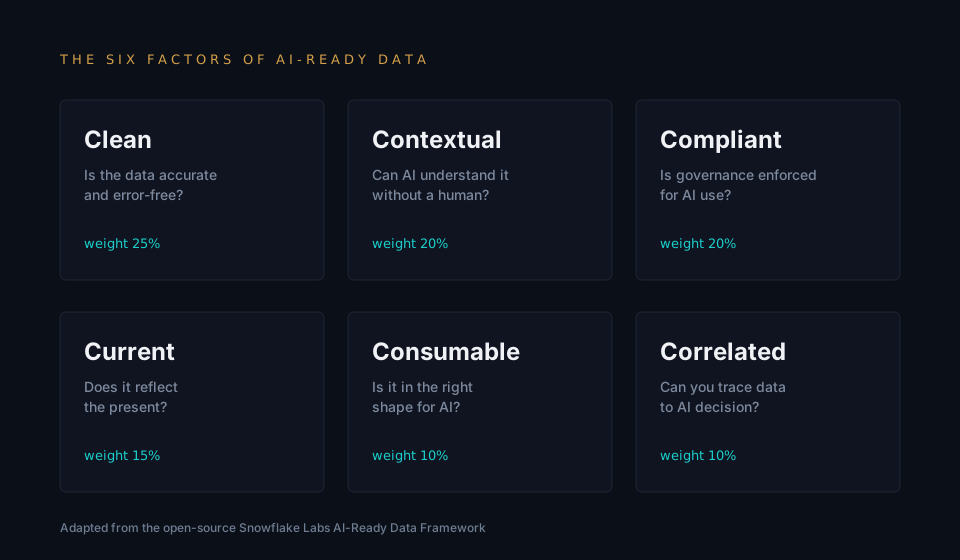
Under those six factors sit 50 specific requirements, selected per workload. A RAG pipeline cares about documentation and freshness. An autonomous agent cares about declared keys and row-level security, because it will query at machine speed and expose whatever it can reach. Model training cares about lineage and PII masking. You pick the workload you are building, and the assessment checks what that workload actually needs.
One thing I refused to compromise on: honest scoring. Some things cannot be measured from metadata. Data accuracy needs value sampling, which we deliberately never do. So instead of faking a number, the report marks those requirements as not assessable and tells you why. A readiness score you cannot trust is worse than no score.
What a scan finds
Here is a real result from a demo estate: a score of 48/100. The schema looked healthy on the surface. Every column typed, three of four tables with sort keys. But the scan found five of six PII columns unmasked, including emails, names, IP addresses, and shipping addresses readable verbatim by any pipeline built on that data. It found 16 of 20 columns undocumented, which means any AI tool working that schema is guessing at meaning. The verdict was blunt: not ready to ship an agent, safe to run a scoped, human-reviewed pilot, and here are the four gates to production, ranked, with estimated score gains for each fix.
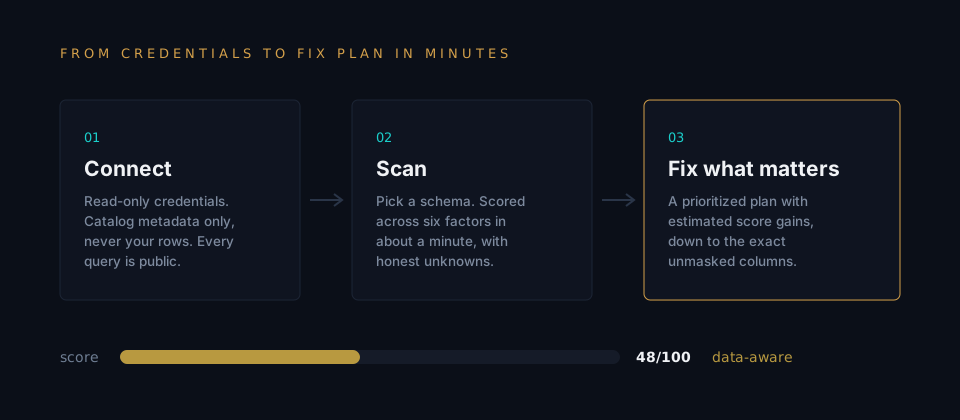
That last part matters most. A score without a plan is trivia. The report tells you what to fix, in what order, with the exact columns named and the estimated readiness points each fix recovers. Want to see a full report before connecting anything? Here is a complete sample on a fictional estate.
Read-only, metadata only, and you can verify that
Asking a data leader to connect a tool to their warehouse is asking for trust, and trust claims are cheap. So we made ours verifiable. MortarIQ connects with read-only credentials and queries catalog metadata only: INFORMATION_SCHEMA, system views, column names, types, timestamps. There is no SELECT against your tables anywhere, and every query we run is published, generated from the connector source so the page cannot drift from what actually executes. Credentials are not stored unless you choose to save a connection, and if your database is not reachable from the internet, a CLI agent runs the same scan inside your network, so credentials never leave it.
Works with the warehouse you already have
MortarIQ scans Google BigQuery, Snowflake, Databricks, PostgreSQL, Amazon Redshift, and Microsoft Fabric, all live-validated against real cloud infrastructure. Lakehouses are covered through their catalogs: Databricks through Unity Catalog, Fabric through both Warehouse and Lakehouse SQL analytics endpoints, and Iceberg or external tables registered in Snowflake and BigQuery through the same catalog views. Managed Postgres flavors like RDS, Cloud SQL, Neon, and Supabase connect through the PostgreSQL connector.
The clock that makes this urgent
Article 10 of the EU AI Act requires documented data governance practices for high-risk AI systems, enforceable from December 2, 2027 (the original August 2026 date was deferred by the Digital Omnibus). If that applies to you, the deferral is build time, not a reprieve: “we never checked our training data” still becomes a regulatory item on a known date. MortarIQ maps findings to seven selectable compliance lenses, including EU AI Act Article 10, NIST AI RMF, ISO/IEC 42001, ISO/IEC 5259, GDPR, SOC 2, and HIPAA. To be precise about what that means: it is readiness to produce evidence, never a certification.
Try it on your own data, free
The free plan runs two assessments a month with the full score and factor breakdown, no credit card. If the score surprises you, the paid plans add the AI fix plan, deeper workload profiles, drift tracking between scans, and a remediation board for running readiness as a program instead of a one-time audit.
I am a solo founder and I read every reply and every support email. If the scan gets something wrong about your estate, I want to know more than you want to tell me.
Get your readiness score.
Connect read-only credentials and see your score and biggest blocker in minutes. Metadata only. Starts free.
Run the free scanFrequently asked questions
What is AI data readiness?
AI data readiness measures whether your data can support AI workloads like RAG, autonomous agents, or model training. It covers six factors: is the data clean, contextual (documented well enough for a machine to understand), compliant (PII masked, access governed), current, consumable, and correlated. A readiness score tells you which factors pass and exactly what blocks the rest.
Does an AI readiness scan read my actual data?
MortarIQ reads catalog metadata only: INFORMATION_SCHEMA, system views, column names, types, and timestamps. It never runs SELECT on your tables, and every query it executes is published at mortariq.com/security/queries. Credentials are read-only and are not stored unless you save the connection.
Which data platforms can be scanned for AI readiness?
Google BigQuery, Snowflake, Databricks, PostgreSQL (including managed flavors like RDS, Cloud SQL, Neon, and Supabase), Amazon Redshift, and Microsoft Fabric, covering both Warehouses and Lakehouses through the SQL analytics endpoint.
How does the EU AI Act affect data readiness?
Article 10 of the EU AI Act requires documented data governance for high-risk AI systems. Enforcement of the high-risk obligations begins December 2, 2027, deferred from August 2026 by the EU's Digital Omnibus. A readiness assessment maps your findings to those obligations so you can produce evidence. It is readiness to produce evidence, not a certification.