Product · June 20, 2026
AI readiness is not a one-time score.
By the MortarIQ Founder · 5 minute read
A readiness score is a photograph of a moving thing. The day you run a scan, it is accurate: your warehouse is documented to here, fresh to there, governed this well. Then the pipelines keep running. A new column lands without a description. A table that used to refresh nightly quietly slips to weekly. An analyst spins up a new schema full of customer records and forgets the masking policy. None of it announces itself, and none of it shows up in the score you already filed away.
That is the problem with treating readiness as a one-time gate. You pass it once, build on top, and the ground shifts underneath you. The score that said “ready” in Q1 is describing a warehouse that no longer exists. So MortarIQ does not stop at a single scan. It watches the score over time, and it tells you when the picture has actually changed.
Why a readiness score decays
Readiness is a property of how your data is organized and governed, and that organization erodes through normal work, not neglect. Every factor MortarIQ scores has a drift mode:
Currentis the one that moves on its own. Freshness is measured against the present, so a table that was “updated yesterday” in March is stale by summer if its load job broke and nobody noticed. The data did not change; time did.
Contextual drifts every time a column ships without documentation. Coverage that was 80 percent slides as the schema grows faster than the descriptions do.
Compliant drifts the moment a new table arrives carrying personal data with no masking policy or classification tag. That is the dangerous one, because it is new exposure, not a known gap.
Clean and Correlated drift when a constraint is dropped in a migration or a declared relationship disappears. Small changes, but they are exactly the kind a one-time scan can never catch.
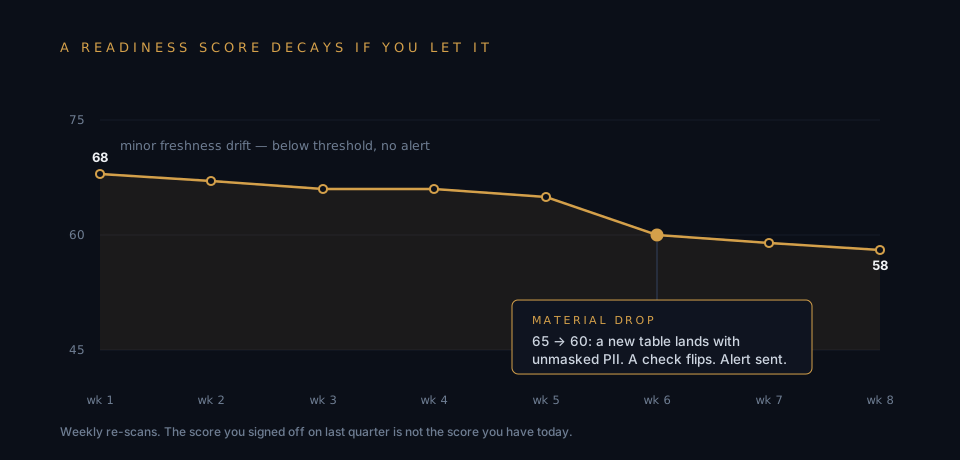
Plotted over a few weeks of re-scans, it looks like this: a slow slide, then a step down when something real breaks.
Monitoring, not re-scanning by hand
Catching drift means re-running the assessment, and nobody is going to do that by hand every week. So on the Team plan, MortarIQ does it for you. You save a read-only connection once, and pick how often each one re-scans: off, monthly, weekly, or daily. Weekly is the default, on purpose. Readiness moves slowly, and a daily re-scan of a slowly-moving estate is mostly noise; weekly catches real change without manufacturing it. If a connection is for a one-off audit, set it to off and it never runs on its own.
The re-scan is the same metadata-only read as the first one. It reads the structure around your data, never the rows inside it, so monitoring is exactly as safe as the initial scan and cheap enough to repeat indefinitely. If you have not seen how that works, the metadata-only method is the place to start.
A score is noise until it is a signal
Here is where most monitoring goes wrong. The easy version emails you after every run, and within a month you have trained yourself to delete it unread. A “your scan finished, still 60/100” message every week is not monitoring; it is a way to guarantee you miss the one that matters.
MortarIQ runs every cycle but only speaks up when your readiness materially changes: the maturity grade flips, the overall score moves by three points or more, or a requirement crosses from pass to fail. A scan that finds only the usual sub-threshold wobble stays silent and carries the previous analysis forward. When something real happens, you get one email with what changed and an updated fix plan.
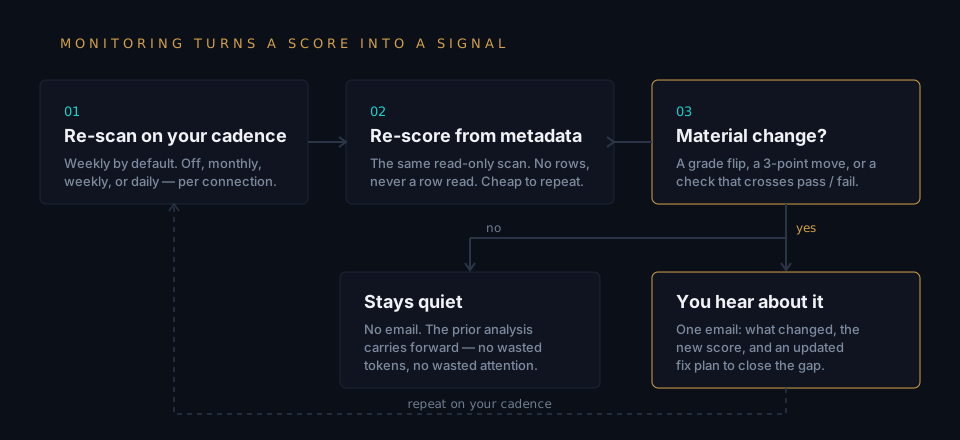
That gate is the whole point. It is the difference between a tool that pages you constantly and one you can actually leave running. Silence means nothing material changed, which is information you can trust precisely because the alternative would have been an email.
Drift you can act on, not just observe
When the score does move, the report shows the change since your last scan: which factors slipped, how far, and which specific checks flipped, including any new PII that appeared without masking. Drift is framed as a delta against the previous assessment, so you see the regression, not just the new number.
And because the same finding can persist across re-scans, the Team remediation boardtracks status by the underlying requirement, not by scan. Close a gap and it stays closed on the next run. If it regresses, the same item reopens against the same owner, so a fix that quietly broke does not just lower a number, it lands back on someone’s list.
Get your readiness score.
Connect read-only credentials and see your score and biggest blocker in minutes. Metadata only. Starts free.
Run the free scanThe honest boundary
Monitoring does not change what a metadata-only scan can and cannot see. Re-scanning weekly tells you the structure around your data has shifted; it still cannot read the values to confirm a tag is complete. The score tracks readiness to produce evidence over time, not a certification, and it never will, because no scan can certify compliance. What it can do is make sure the number you are trusting is the number you actually have. For the compliance angle in depth, see EU AI Act Article 10, and for the six factors themselves, see Is your data ready for AI?
Frequently asked questions
How often does MortarIQ re-scan my data?
You choose, per connection: off, monthly, weekly, or daily (hourly on Enterprise). Weekly is the default, because AI readiness drifts slowly and a daily re-scan rarely tells you anything a weekly one would not. Scheduled monitoring is a Team-plan feature; Free and Pro can re-scan on demand instead, Pro without limit and Free within its monthly scan allowance.
Will scheduled scans flood me with alerts?
No. A re-scan only emails you when your readiness materially changes: the maturity grade flips, the overall score moves by three points or more, or a requirement crosses from pass to fail. A scan that finds nothing new stays silent and reuses the prior analysis, so you are never paged to be told the score is still the same.
What counts as data drift in a readiness assessment?
Anything that changes the structure and governance around your data: a table whose freshness has slipped past its window, new columns that landed without documentation, a new table carrying personal data with no masking policy, a dropped constraint, or a classification tag that was removed. All of it is visible in catalog metadata, so MortarIQ measures the drift without ever reading a row.
Does monitoring read my data?
No. A scheduled re-scan is the same read-only, metadata-only assessment as the first scan. It reads schema, descriptions, types, freshness timestamps, relationships, masking policies, and classification tags, and never runs a SELECT against your tables. Credentials for a saved connection are encrypted at rest with AES-256-GCM.
Which plan includes scheduled monitoring?
Scheduled, automatic re-scans are part of the Team plan and above. Free and Pro run assessments on demand instead (Pro unlimited, Free within its monthly limit); Team adds the saved-connection schedule, the per-connection cadence, drift alerts, and a remediation board whose status persists across re-scans.
Want to see what a scan produces before you connect anything? Read a sample readiness report built entirely from metadata.